
Your Website Needs Funnels
A website on its own is not a magic customer machine. It is an important part of your business, but it still needs people to find it, visit it and take action.
For regional small businesses, this is especially important. You might have a great website, a strong local reputation and a loyal customer base, but if people are not being regularly reminded that you exist, they may not think of you when they need your product or service.
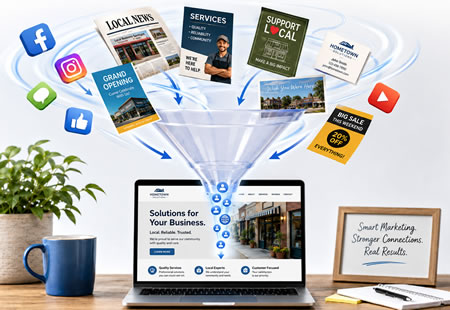
That is where social media and physical advertising come in.
Think of your website as the main destination. It is where people can learn more about your business, view your services, browse your products, read your story, check your opening hours, make an enquiry or place an order. Your social media posts, flyers, signs, business cards, vehicle signage and local advertising are the funnels that guide people there.
Social Media
Social media is great for staying visible. It allows you to remind people what you do, show recent work, share updates, promote specials, answer common questions and keep your business in front of your local community. But social media should not be the only place your business lives online.
The problem with relying only on Facebook or Instagram is that you do not fully control them. Algorithms change, posts disappear quickly, accounts can be restricted, and not everyone sees every update. Your website gives you a more stable home base. Social media should lead people back to that home base.
For example, instead of simply posting “We now offer gift vouchers”, you could write a short post that says, “Our gift vouchers are now available online – perfect for birthdays, thank-you gifts or last-minute presents.” Then link directly to the gift voucher page on your website.
Physical advertising.
A flyer, poster, shopfront sign, newspaper ad or business card should not just display your logo and phone number. It should give people a clear next step. That might be “View our full range online”, “Book your appointment on our website”, “See our latest projects”, “Download our menu” or “Scan the QR code to make an enquiry.”
QR codes can be very useful for regional businesses because they make it easy for people to move from the physical world to your website. A customer might see your sign at a market, a poster on a noticeboard, an ad in a local program or a sticker on your work vehicle. If there is a QR code taking them directly to the right page, you have made the next step simple.
The key is to send people to the most relevant page, not always the home page. If you are promoting accommodation, send them to the booking page. If you are advertising a special offer, send them to that offer. If you are promoting an event, send them directly to the event details or ticket page.
Every funnel should have a purpose.
A good social post should make people curious enough to click. A good flyer should make people want to scan. A good sign should make people remember your name. A good website should then do the heavier lifting – explaining, reassuring and making it easy to contact you or buy from you.
This is where many small businesses fall short. They promote their business, but they do not connect the dots. Their Facebook post does not link anywhere. Their flyer has no website address. Their ad gives no clear action. Their website does not match the thing they are promoting.
When everything works together, your marketing becomes much stronger.
Your website, social media and physical advertising should not be treated as separate things. They should support each other. Social media creates regular awareness. Physical advertising builds local recognition. Your website provides the details, trust and action point.
For regional small businesses, this approach is practical, affordable and powerful. You do not need to be everywhere. You just need to be clear, consistent and easy to find.
Your website is the destination. Make sure every signpost points people in the right direction.

 greg@tropicalcoastwebdesign.com.au


